
Dates in Japanese: Days, Months, and Years

Learning how to say dates, days, and years is a core foundation of Japanese study. Japanese culture values punctuality highly. Mastering this material helps everyday conversation, appointments, and reading train schedules.
This article covers the full Japanese calendar system: weekday names, dates (with many exceptions!), months, and the unique imperial year system.
Because this topic depends heavily on numbers, read Japanese numbers first if you are not yet comfortable with 1–100.
1. Days of the Week (Youbi)
Japanese weekday names come from natural elements (fire, water, wood, metal, earth) plus the sun and moon—similar to old planetary naming. Each day ends with 曜日 (Youbi).
Here is the list:
| English | Kanji | Reading (romaji) | Element / literal meaning |
|---|---|---|---|
| Monday | 月曜日 | Getsuyoubi | Moon |
| Tuesday | 火曜日 | Kayoubi | Fire |
| Wednesday | 水曜日 | Suiyoubi | Water |
| Thursday | 木曜日 | Mokuyoubi | Wood |
| Friday | 金曜日 | Kinyoubi | Gold/metal |
| Saturday | 土曜日 | Doyoubi | Earth |
| Sunday | 日曜日 | Nichiyoubi | Sun |
Memory tips:
- Getsu (Monday) — moon (月).
- Ka (Tuesday) — fire (火).
- Sui (Wednesday) — water (水).
- Moku (Thursday) — wood (木).
- Kin (Friday) — gold/metal (金).
- Do (Saturday) — earth (土).
- Nichi (Sunday) — sun (日).
In casual speech or short calendar labels, “youbi” is often dropped, leaving only the element: 月 (Getsu), 火 (Ka), 水 (Sui), and so on.
Real example: FFXIV maintenance schedule
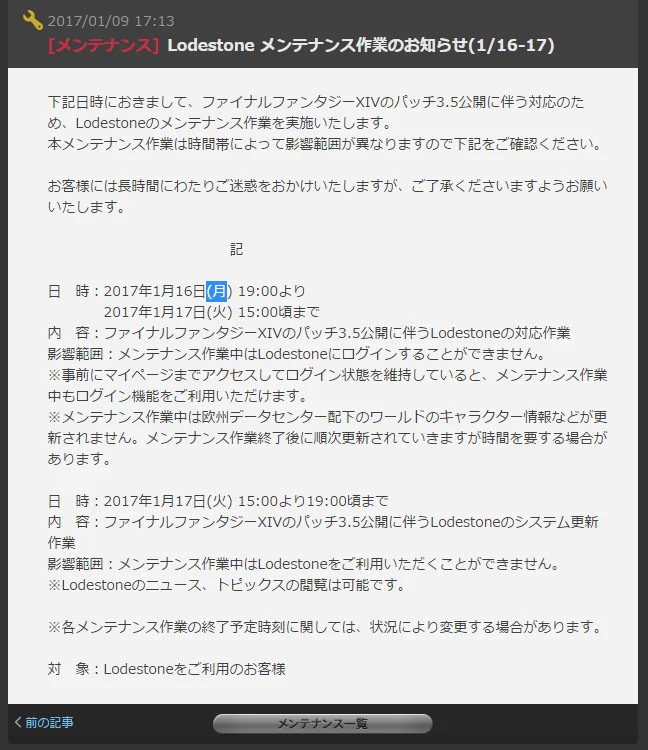
In the image above, 「曜日」is not used—only 月 (Monday) and 火 (Tuesday) appear.
2. Dates of the Month (Hizuke)
This is the trickiest part for beginners. Unlike English ordinals that mostly follow a regular pattern, Japanese has special readings for the 1st–10th, plus the 14th, 20th, and 24th.
The general formula is number + Nichi (日). Watch the exceptions marked in red below.
Quick reference table: dates 1–30
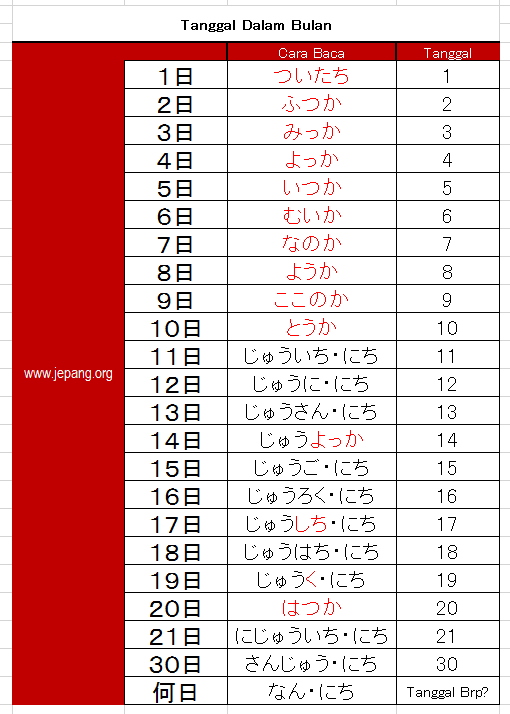
Dates 1 to 10 (must memorize!)
- 1st: 一日 (Tsuitachi) — Not Ichinichi!
- 2nd: 二日 (Futsuka)
- 3rd: 三日 (Mikka)
- 4th: 四日 (Yokka)
- 5th: 五日 (Itsuka)
- 6th: 六日 (Muika)
- 7th: 七日 (Nanoka)
- 8th: 八日 (Youka)
- 9th: 九日 (Kokonoka)
- 10th: 十日 (Tooka)
Dates 11 to 31 (regular pattern + exceptions)
From the 11th, most dates return to number + Nichi, but watch 4, 9, and 20.
| Date | Kanji | Reading | Notes |
|---|---|---|---|
| 11 | 十一日 | Juu-ichi-nichi | Regular |
| 12 | 十二日 | Juu-ni-nichi | Regular |
| 13 | 十三日 | Juu-san-nichi | Regular |
| 14 | 十四日 | Juu-yokka | Exception |
| 15 | 十五日 | Juu-go-nichi | Regular |
| 16 | 十六日 | Juu-roku-nichi | Regular |
| 17 | 十七日 | Juu-shichi-nichi | - |
| 18 | 十八日 | Juu-hachi-nichi | - |
| 19 | 十九日 | Juu-ku-nichi | - |
| 20 | 二十日 | Hatsuka | Special exception |
| 21 | 二十一日 | Ni-juu-ichi-nichi | Regular |
| 22 | 二十二日 | Ni-juu-ni-nichi | Regular |
| 23 | 二十三日 | Ni-juu-san-nichi | Regular |
| 24 | 二十四日 | Ni-juu-yokka | Exception |
| ... | ... | ... | ... |
| 29 | 二十九日 | Ni-juu-ku-nichi | - |
| 30 | 三十日 | San-juu-nichi | - |
| 31 | 三十一日 | San-juu-ichi-nichi | - |
Key points:
- The 20th (Hatsuka) is the exception beginners mispronounce most. Do not say “Ni-juu-nichi”.
- The 4th, 14th, and 24th always use the "yokka" sound (Yokka, Juu-yokka, Ni-juu-yokka).
3. Month Names (Gatsu)
Months are much easier than dates. Formula: number + Gatsu (月).
| Month | Kanji | Reading |
|---|---|---|
| January | 一月 | Ichigatsu |
| February | 二月 | Nigatsu |
| March | 三月 | Sangatsu |
| April | 四月 | Shigatsu (Not Yongatsu) |
| May | 五月 | Gogatsu |
| June | 六月 | Rokugatsu |
| July | 七月 | Shichigatsu (Not Nanagatsu) |
| August | 八月 | Hachigatsu |
| September | 九月 | Kugatsu (Not Kyuugatsu) |
| October | 十月 | Juugatsu |
| November | 十一月 | Juuichigatsu |
| December | 十二月 | Juunigatsu |
Watch out: April (Shi-gatsu), July (Shichi-gatsu), and September (Ku-gatsu) differ slightly from ordinary number readings.
4. Year Systems (Nen & Gengou)
Japan has two common ways to name years:
- Western calendar (Seireki): same as 2023, 2024, etc.
- Japanese era (Gengou): based on the reign of the emperor.
Western method (Seireki)
Say the number, then add Nen (年).
- 2024: 2024年 (Nisen-nijuuyo-nen).
- 1990: 1990年 (Sen-kyuuhyaku-kyuujuu-nen).
Japanese era method (Gengou)
Still very common on official government, bank, and admin forms. The era changes when a new emperor takes the throne.
- Reiwa (令和): from 1 May 2019 – present.
- Heisei (平成): 8 January 1989 – 30 April 2019.
- Showa (昭和): 25 December 1926 – 7 January 1989.
- Taisho (大正): 1912 – 1926.
- Meiji (明治): 1868 – 1912.
Conversion tip (year 2024): We are in the Reiwa era. Reiwa year 1 = 2019. So 2024 − 2018 = Reiwa 6 (令和6年).
5. Relative Time Words
Besides exact dates, we often say “yesterday,” “tomorrow,” “the day after tomorrow.”
Days
- Today: 今日 (Kyou)
- Tomorrow: 明日 (Ashita)
- The day after tomorrow: 明後日 (Asatte)
- Yesterday: 昨日 (Kinou)
- The day before yesterday: 一昨日 (Ototoi)
Weeks (Shuu)
- This week: 今週 (Konshuu)
- Next week: 来週 (Raishuu)
- The week after next: 再来週 (Saraishuu)
- Last week: 先週 (Senshuu)
- The week before last: 先々週 (Sensenshuu)
Months (Tsuki)
- This month: 今月 (Kongetsu)
- Next month: 来月 (Raigetsu)
- Last month: 先月 (Sengetsu)
Years (Nen)
- This year: 今年 (Kotoshi) — special reading!
- Next year: 来年 (Rainen)
- The year after next: 再来年 (Sarainen)
- Last year: 去年 (Kyonen)
- The year before last: 一昨年 (Ototoshi)
6. Duration (Kikan)
Separate a point in time from a duration (span). Duration often adds Kan (間), with some exceptions.
- 1 day (duration): 一日 (Ichinichi). Compare with Tsuitachi (the 1st of the month).
- 2 days: 二日間 (Futsukakan).
- 1 week: 一週間 (Isshuukan).
- 1 month: 一ヶ月 (Ikkagetsu). Note the small tsu.
- 1 year: 一年間 (Ichinenkan).
7. Example Sentences and Conversations
Here are real usage patterns. Written format order is usually year – month – date – weekday.
Format:
2024年5月17日 (金) Nisen-nijuuyo-nen, Gogatsu, Juu-shichi-nichi, Kinyoubi.
Conversation 1: Asking the date
A: What’s today’s date? 今日は何日ですか? (Kyou wa nan-nichi desu ka?)
B: Today is March 3. 今日は三月三日です。 (Kyou wa sangatsu mikka desu.)
Conversation 2: Birthday
A: When is your birthday? 誕生日はいつですか? (Tanjoubi wa itsu desu ka?)
B: My birthday is December 25. 十二月二十五日です。 (Juunigatsu nijuugonichi desu.)
Conversation 3: Duration
A: How long did you live in Japan? どのくらい日本に住んでいましたか? (Dono kurai Nihon ni sunde imashita ka?)
B: About 3 years. 約三年間です。 (Yaku san-nen-kan desu.)
8. Practice: Check Your Understanding
Q1: How do you say “August 4” in Japanese?
Answer: 八月四日 (Hachigatsu yokka — remember, the 4th is yokka, not yonka!)
Q2: What day is “金曜日”?
Answer: Friday (Kinyoubi — from 金 = gold/metal)
Q3: What Reiwa year is 2026?
Answer: 令和8年 (Reiwa Hachinen). Formula: 2026 − 2018 = 8.
Q4: How do you say “I lived in Japan for 2 years”?
Answer: 日本に二年間住んでいました。(Nihon ni ni-nen-kan sunde imashita.)
Conclusion
Japanese dates take extra effort—especially the 1st–10th and exceptions like the 14th, 20th, and 24th. Once the patterns stick, planning with Japanese friends becomes far easier.
Key points:
- Months use a simple formula: number + 月 (Gatsu).
- Dates 1–10 use traditional Japanese readings (Tsuitachi, Futsuka, Mikka, etc.) — must memorize.
- Weekdays use planet/element names (Nichi, Getsu, Ka, Sui, Moku, Kin, Do).
- Years can use the Western calendar (Seireki) or Japanese eras (Reiwa/Heisei/Showa).
- Duration often adds Kan (間) to distinguish a span from a point in time.
Look at a calendar each morning and say today’s date in Japanese!
Related reading:
頑張って! (Ganbatte / Keep going!)
Previous: ← Telling time in Japanese
Next: Japanese numbers →