
Learn Katakana: Usage Rules and Long Vowels
If you have already learned katakana letter shapes from Katakana Letters and How to Write Them, well done—you are already closer to reading restaurant menus in Japan. Shapes alone are not enough, though. Katakana has rules you will not find in hiragana, especially how it writes sounds from foreign languages.
Ever wonder why “Coffee” becomes “Koohii”? Or why “Bed” becomes “Beddo”? This guide walks through the logic behind katakana: long vowels, double consonants, and modern sounds that traditional Japanese never needed.
Want to practice right away?
Drill katakana with interactive practice in Labs. Short, repeated sessions help the shapes stick.
Open Katakana practice
1. When Is Katakana Used?
Before the charts, it helps to know when katakana shows up:
- Foreign loanwords (gairaigo): Almost all non-Chinese foreign words. Examples: コンピューター (computer), テレビ (television).
- Foreign names: Non-Japanese personal names and place names. Examples: インドネシア (Indonesia), ジャカルタ (Jakarta).
- Onomatopoeia: Sound-effect words such as ワンワン (woof-woof) or ドキドキ (heart pounding).
- Emphasis: Similar to CAPS or italics for stress.
- Scientific names: Animal and plant species in academic contexts.
- Company and brand names: Many Japanese companies write their names in katakana.
2. The Main Chart: Gojūon (Fifty Sounds)
Here are the 46 basic katakana forms.
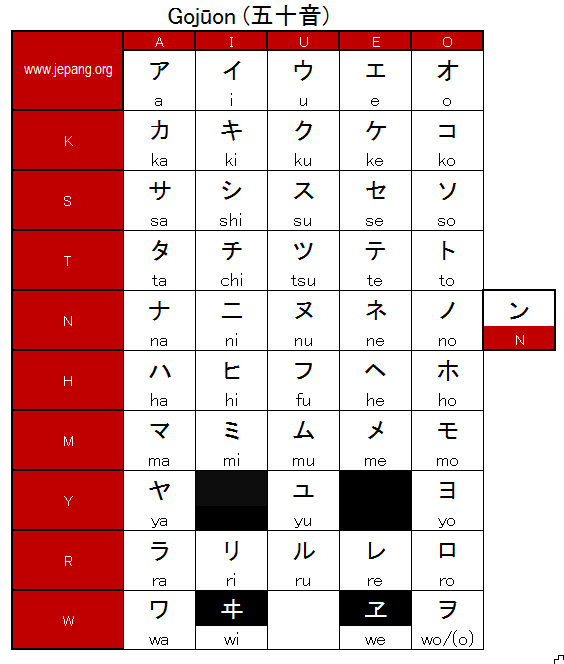
- The first row (ア、イ、ウ、エ、オ) is the five core vowels (a, i, u, e, o).
- ヰ (Wi) and ヱ (We) are no longer used.
- へ (He) looks exactly like its hiragana counterpart.
Important Tips: Look-Alike Letters
Beginners often mix these up. Watch the stroke direction!
-
Shi (シ) vs Tsu (ツ)
- Shi (シ): Two short strokes lined downward (more vertical). The main stroke pulls upward. (Picture a tilted smile.)
- Tsu (ツ): Two short strokes lined sideways (more horizontal). The main stroke pulls downward.
-
So (ソ) vs N (ン)
- So (ソ): The first stroke slants down. The main stroke pulls downward.
- N (ン): The first stroke is flatter. The main stroke pulls upward.
Tip: “Shi” and “N” pull up (think “shin”); “Tsu” and “So” pull down.
3. Dakuon (Voiced Sounds)
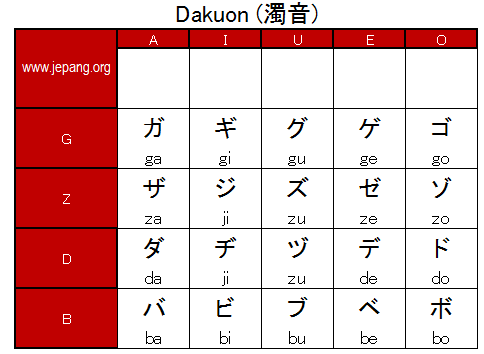
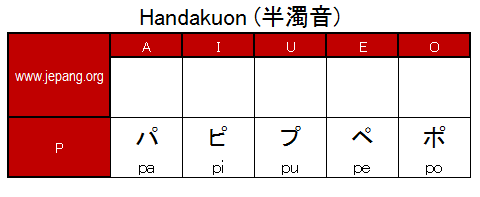
Like hiragana, katakana uses tenten (two dots) to voice a sound (K → G, S → Z, T → D, H → B).
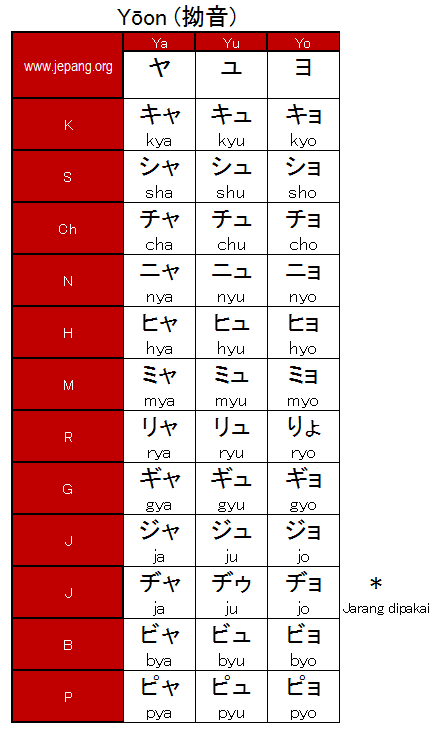
4. Yōon (Contracted Sounds)
Consonants combined with small ya, yu, or yo.
5. Chōonpu (Long Vowels)
The standout katakana rule is the straight dash (ー), called chōonpu. It lengthens the vowel of the previous letter.
In hiragana, long vowels use an extra vowel letter (for example おかあさん — okaasan). In katakana, you use this dash instead.
Key examples
Long vs short can change the meaning completely.
| Katakana | Romaji | Source | Meaning |
|---|---|---|---|
| ビル | Biru | Building | Building |
| ビール | Biiru | Beer | Beer |
| おばさん | Obasan | - | Aunt |
| おバーさん | Obaasan | - | Grandmother |
More Examples:
- カー (Kaa) → Car
- カード (Kaado) → Card
- コーヒー (Koohii) → Coffee
- コンピューター (Konpyuutaa) → Computer
Tip: In vertical writing (top to bottom), the chōonpu stands vertical as well ( | ).
6. Sokuon (Double Consonants / Small Tsu)
Like hiragana, katakana uses a small tsu (ッ) for a pause or doubled consonant. It shows up even more often because English often hits syllables hard.
General rule: the small tsu doubles the following consonant.
When is it used?
Usually to mimic a clipped English ending (-t, -ck, -p, -d).
| Foreign word | Katakana | Romaji | Notes |
|---|---|---|---|
| Bed | ベッド | Beddo | Final “d” needs “o” and a strong hit. |
| Bag | バッグ | Baggu | Final “g” needs “u” and a strong hit. |
| Cup | カップ | Kappu | Short, sharp “p”. |
| Internet | インターネット | Intaanetto | Stressed “net”. |
| Ticket | チケット | Chiketto | Final “et”. |
Exception: English long vowels usually do not use small tsu—they use chōonpu.
- Note (notebook) → ノート (Nooto), not Notto.
- Cute → キュート (Kyuuto).
7. Extra Modern Sound Combinations
Traditional Japanese has a limited sound range. There is no native “Ti”, “Di”, “Fa”, “Wi”, or “V”. As more foreign words arrived, katakana grew new combinations with small vowels.
These show up constantly in tech and place names.
F sounds (Fa, Fi, Fe, Fo)
Japanese only had “Fu” (フ) originally.
- Fa = ファ → ファイト (Faito / Fight)
- Fi = フィ → フィリピン (Firipin / Philippines)
- Fe = フェ → フェースブック (Feesubukku / Facebook)
- Fo = フォ → フォーク (Fooku / Fork)
T & D sounds (Ti, Tu, Di, Du)
Originally Chi and Tsu.
- Ti = ティ → パーティー (Paatii / Party)
- Di = ディ → ディズニー (Dizunii / Disney)
- Tu = トゥ → トゥ (Two)
- Du = ドゥ → ドゥ (Do)
W sounds (Wi, We, Wo)
- Wi = ウィ → ウィキペディア (Wikipedia)
- We = ウェ → ウェブサイト (Webusaito / Website)
- Wo = ウォ → ウォーター (Wootaa / Water)
V sounds (Va, Vi, Vu, Ve, Vo)
Japanese often substitutes “B” for “V” (Video → Bideo). For closer accuracy, you can use U with tenten (ヴ).
- Va = ヴァ (Violin → Vaiorin)
- Vi = ヴィ
- Ve = ヴェ
- Vo = ヴォ
8. Transcription Logic: English to Japanese
How do English words become katakana? Patterns help.
1. Final T and D → add “o”
Because T and D feel “hard,” they usually take “o”.
- Hint → ヒント (Hinto)
- Salad → サラダ (Sarada) — exception: sometimes “a”
- Gold → ゴールド (Goorudo)
2. Final C, B, F, G, K, L, M, P, S → add “u”
Most other consonants take “u” (the weakest Japanese vowel).
- Milk → ミルク (Miruku)
- Post → ポスト (Posuto) — S takes u, T takes o
- Gum → ガム (Gamu)
3. L and R → both become “R”
No L/R contrast.
- Lock → ロック (Rokku)
- Rock → ロック (Rokku)
- Context tells them apart.
4. “Th” → “S” or “Z”
- Thank you → サンキュー (Sankyuu)
- The → ザ (Za)
9. Special Uses of Katakana
Beyond loanwords, katakana has other roles:
-
Emphasis Like italics or CAPS.
- In comics, a monster might say: 「アライマス」 (A-ra-i-ma-s / I exist), with a robotic feel.
- For stress: “That is VERY important” → 「それはホンキで大事」 (Honki in katakana).
-
Sound effects (onomatopoeia) Manga is full of katakana SFX.
- Doki-doki (ドキドキ): Heartbeat.
- Peka-peka (ペカペカ): Sparkling.
- Baan! (バーン): Slam or explosion.
10. Loanword Quiz (Gairaigo)
Read each word and guess the English source!
- ニュース (Nyuusu)
- アイスクリーム (Aisukuriimu)
- スーパー (Suupaa)
- ハンバーガー (Hanbaagaa)
- クリスマス (Kurisumasu)
- スマートフォン (Sumaatofon)
- コンビニ (Konbini)
Click to show answers
- News
- Ice Cream
- Supermarket
- Hamburger
- Christmas
- Smartphone
- Convenience Store
Conclusion
Learning katakana is more than memorizing shapes. It also means training your ear to Japanese sound logic. At first “Makudonarudo” may sound funny; soon you can often guess how an English word will sound in Japanese.
Key points:
- 46 basic letters (Gojūon) — more angular than hiragana.
- Used for: foreign loanwords, foreign names, onomatopoeia, and emphasis.
- Chōonpu (ー) marks long vowels — different from hiragana.
- Look-alike pairs: シ/ツ (Shi/Tsu) and ソ/ン (So/N).
- Transcription logic: foreign sounds adapt to Japanese CV syllables.
Next step: read product labels, film titles, or game character names. Katakana is everywhere.
Related material:
頑張って! (Ganbatte / Keep going!)
Previous: ← Understanding furigana
Next: Katakana letters and how to write them →