
Learn Hiragana: A Fast Way to Memorize and Read

You have already seen the hiragana chart, and those curved shapes may make your head spin. “How am I supposed to memorize 46 odd forms?”
Do not worry. Thousands of learners before you have done it, and so can you. The key is not raw IQ—it is method. Blind rote memorization is boring and fades quickly. The better approach is mnemonics (memory hooks) plus the special reading rules that textbooks often skip at the start.
This article does not teach stroke order (that is here). It teaches how to remember and read hiragana correctly—including the “secret” rules many beginners never hear early enough.
1. Mnemonics: Turn Shapes into Stories
The brain remembers pictures more easily than abstract lines. Let’s turn a few of the harder hiragana into images.
A (あ)
Picture this letter as an apple with a stem. Or someone yelling “Aaa!” at an antenna.
- Hook: Antenna / apple.
I (い)
It looks like two eels standing side by side. Or a pair of legs stepping out with “Itte kimasu” (I’m heading out).
- Hook: Eel / Itte kimasu.
Mu (む)
The small circle in the middle looks like a cow’s nose. Cows say “Mooo.”
- Hook: Mooo (cow).
Shi (し)
It looks exactly like a fishing hook.
- Hook: Fi-SHI-ng.
Tsu (つ)
It looks like a big tsunami wave.
- Hook: Tsunami.
He (へ)
It looks like a mountain peak. Climbing a mountain feels like “heaven”—or like something “heavy.”
- Hook: Heaven / heavy.
Make up your own story for every letter! The sillier it is, the stickier the memory.
2. The Main Chart: Gojūon (Fifty Sounds)
Hiragana’s main job is to form Japanese sentences. The chart below shows the 46 basic hiragana forms. It is called Gojūon (五十音), “fifty sounds,” even though there are only 46 letters in practice.
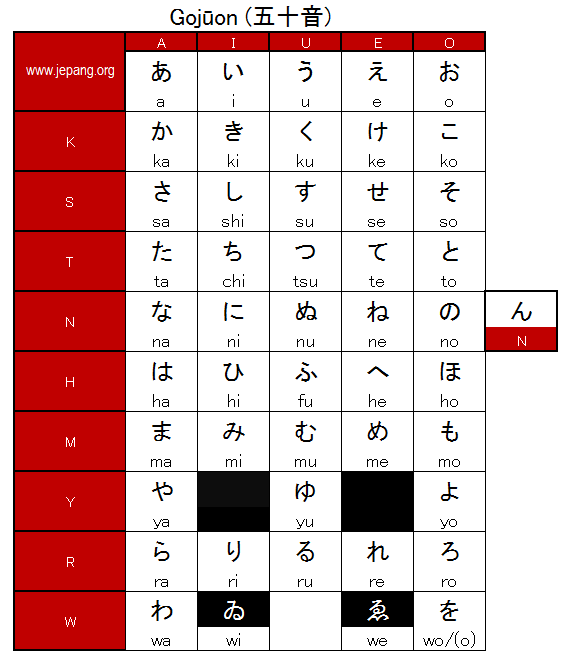
- The first row (あ、い、う、え、お) is the five core vowels of Japanese (a, i, u, e, o).
- ゐ (wi) and ゑ (we) are obsolete and have not been used since 1946.
- は (ha) is sometimes read “wa” when it works as a particle.
- を (wo) is sometimes read “o” when it works as a particle.
3. Dakuon (Voiced Sounds)
Next are dakuon (濁音), the “muddy” or voiced sounds. They use two quote-like marks (tenten) at the top right of a letter.
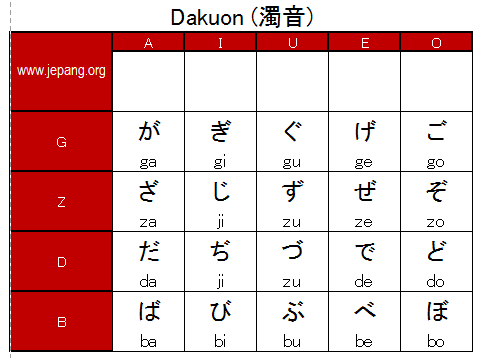
Special notes:
- ず (zu) vs づ (dzu/zu): Once distinguished, both are now usually read “zu.” づ appears only in certain words such as tsudzuku (to continue) or kidzuku (to notice).
- じ (ji) vs ぢ (dji/ji): Both are read “ji.” じ is far more common.
4. Yōon (Contracted Sounds)
Yōon (拗音) combines a consonant syllable with a small ya, yu, or yo.
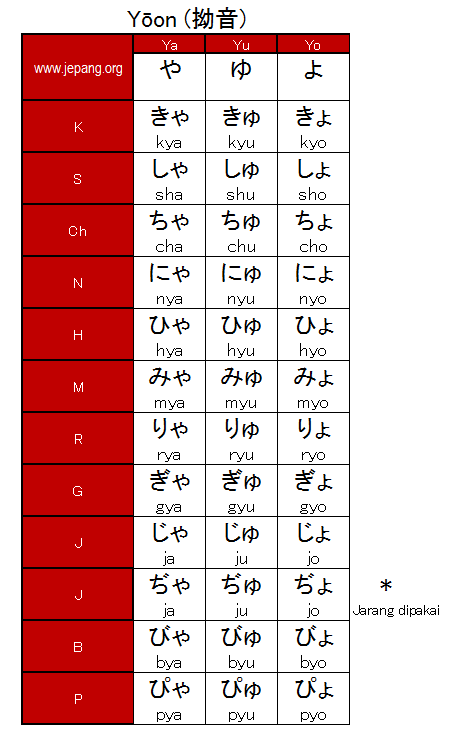
Notice that ya, yu, and yo are written smaller (about half size).
- Ki + small ya = kya (not ki-ya).
- Shi + small yo = sho.
5. Other Modern Letters
These forms did not always exist, but modern Japanese needs ways to write foreign sounds.
- Fa = ふぁ
- Ti = てぃ
- Du = どぅ
- We = うぇ
- Fo = ふぉ
Watch for the small vowels (ぁ, ぃ, ぅ, ぇ, ぉ) that follow the main letter.
6. Special Reading Rules (Particle Exceptions)
In general, hiragana is read as written. There are three big exceptions when a letter works as a particle (grammar marker).
1. Ha (は) is read “wa”
When は marks the topic (the particle wa), it is pronounced wa.
- Written: わたしは (Watashi ha)
- Read: Watashi wa (I am… / As for me…)
2. He (へ) is read “e”
When へ marks direction (the particle e), it is pronounced e.
- Written: にほんへ (Nihon he)
- Read: Nihon e (to Japan)
3. Wo (を) is read “o”
を was originally closer to “wo” (with a faint w). In modern Japanese it almost only marks the object of a verb and is read squarely as o.
- Written: すしをたべる (Sushi wo taberu)
- Read: Sushi o taberu (eat sushi)
7. Long Vowels (Chōon) in Hiragana
Katakana uses a dash (ー) to lengthen a sound. Hiragana adds another vowel letter instead. That often confuses beginners.
Long-vowel rules:
-
Long A (aa): add あ.
- お母さん (O-ka-a-sa-n) → Read: Okaasan.
-
Long I (ii): add い.
- お兄さん (O-ni-i-sa-n) → Read: Oniisan.
-
Long U (uu): add う.
- 空気 (K-u-ki) → Read: Kuuki (air).
-
Long E (ee): usually add い (most common) or え (rare).
- Important: E + I is read ee (long e), not “ei.”
- 先生 (Se-n-se-i) → Read: Sensee.
- 映画 (E-i-ga) → Read: Eega.
-
Long O (oo): usually add う (most common) or お (rare).
- Important: O + U is read oo (long o), not “ou.”
- おはよう (O-ha-yo-u) → Read: Ohayoo.
- 王様 (O-u-sa-ma) → Read: Oosama (king).
Trap: Many beginners still pronounce a final “i” in “Sensei” or a final “u” in “Arigatou.” Stretch the previous vowel instead: “Sensee…,” “Arigatoo….”
8. Sokuon (Pause / Small Tsu)
In hiragana, the small tsu (っ) doubles the following consonant, just as in katakana. It creates a short “hiccup” or hold.
- Matte (wait) → まって (Ma-t-te).
- Kippu (ticket) → きっぷ (Ki-p-pu).
- Gakkou (school) → がっこう (Ga-k-ko-u).
- Sappari (refreshing) → さっぱり.
- Kappa (mythical creature) → かっぱ.
How to say it: hold one beat on the small tsu. “Ga” (hold) “kou.”
9. Practice: Real Japanese Words
Try reading these words written entirely in hiragana. Watch long vs short vowels.
| Hiragana | Romaji (literal) | Correct reading | Meaning |
|---|---|---|---|
| ありがとう | A-ri-ga-to-u | Arigatoo | Thank you |
| せんせい | Se-n-se-i | Sensee | Teacher |
| こうこう | Ko-u-ko-u | Kookoo | High school |
| ゆうめい | Yu-u-me-i | Yuumee | Famous |
| おねえさん | O-ne-e-sa-n | Oneesan | Older sister |
| こんにちは | Ko-n-ni-chi-ha | Konnichiwa | Hello / good afternoon |
10. Tips for Typing Hiragana on Devices
In daily digital life you will type Japanese more often than you write it by hand. Phones and computers use romaji-to-kana input: you type Latin letters, and the system converts them to hiragana.
Tips that often trip beginners:
-
Typing particles:
- For the particle “wa” (は), type HA (not WA—that gives わ).
- For the particle “o” (を), type WO (not O—that gives お).
- For the particle “e” (へ), type HE.
-
Typing small tsu (っ):
- Type a double consonant. Example:
Gakkou→ がっこう. - Manual way: type
xorlbeforetu.xtu→ っ.
- Type a double consonant. Example:
-
Typing small vowels (aa, ii, uu, and so on):
- For unusual combinations, type
xorlbefore the letter. xa→ ぁ.xi→ ぃ.
- For unusual combinations, type
-
Typing “n” (ん):
- Type
nn(two n’s). A singlenplus space can confuse the IME about whether you want ん or na/ni/nu….
- Type
-
Shortcuts:
- Ti → ち (chi).
- Tu → つ (tsu).
- Si → し (shi).
- Input engines are flexible: both
siandshiusually produce し.
Practice: Test Your Reading
Try these simple hiragana sentences. Read first, then open each answer one by one.
Question 1
わたしは がくせいです。
Answer: Watashi wa gakusei desu. (I am a student.)
Question 2
あした おかあさんと いっしょに おおさかへ いきます。
Answer: Ashita okaasan to issho ni Oosaka e ikimasu. (Tomorrow I will go to Osaka with my mother.)
Question 3
Watch the particles — which ones are read differently from how they are written?
Answer: は is read wa (not "ha") and へ is read e (not "he") when used as particles.
Conclusion
Memorizing hiragana shapes is only the first step. The real work is training your eyes and tongue on rules like long vowels (Sensei → Sensee) and particles (ha → wa).
Key points to lock in:
- 46 basic letters (Gojūon) — the foundation.
- Dakuon (゛) and handakuon (゜) add more sounds.
- Yōon (ゃ, ゅ, ょ) merges sounds into new syllables.
- Particle rules: は → wa, へ → e, を → o.
- Long vowels use extra vowel letters (おう, ええ, and so on), not a dash.
- Sokuon (っ) doubles the next consonant.
Do not only memorize the chart in order (A, I, U, E, O…). Shuffle your flashcards. The brain loves to cheat by learning order instead of shape.
Once you can read hiragana smoothly, Japanese opens up. Next steps? Katakana and kanji!
Related material:
頑張って! (Ganbatte / Keep going!)
Previous: ← Tutorial index
Next: Hiragana letters and how to write them →